Various Lies

Tuesday, June 21, 2011

The good fight

Now, I had it in my head to have a talk about another thing that had happened to me, and had, by coincidence, and nothing more so help me FSM*, happened to a friend of mine. However, someone has had the temerity, and so help them FSM for their forthright attitude, which I cannot help but admire, to challenge me on something I think an adult could reason without recourse to challenge***.

Now I want to preface this by making clear the loss of any life is an awful thing, because this blog post involves an interaction between me and a MediaHound that concerns a recent, local loss of life. Not just a car crash, RTA, but a fatality.  I can only imagine the pain these families are living in.   I also appreciate all the hard work our local NewsHounds do to keep regular Joes like me up to date and clued in with everything that might affect us. Like a major fatality crash nearby. Important for two reasons, one opening us up to the shared pain of loss, and one a simple matter of local infrastructure.

There was a crash, in Arkansas, involving a TDOT vehicle. And people died. Our local NewsHounds posted about this on the Twitters, and, I guess, being as voyeurostic as they hoped I'd be, I looked at the photo....

But it's a picture of a (T)DOT truck with dented side panels. There is nothing but a picture of a truck. And of course the usual interchoobs commentary. And suddenly I am struck with regret for my own voyeurism and...something more...

Why the FSM would a news channel have this on their Facebook page? It seems cruel and unnecessary to do this. The corollary is why are we driven as conusmers to look at this: Because they provide us with content we demand**.

Its just a dented truck - it adds nothing to the story, it brings no new information to the situation, it in fact, I dare to suggest, does nothing at all but runs the risk of inflaming opinion.

I expect, by definition the news media to give me information. There was no information in this photograph, other than the pointed statement of here is a dented truck.

So to this I tweet,


 (I also 'broke' the URL so it couldnt be followed directly)

and with all due respect @3onyourside, the twitter feed of the news agency WREG, wrote back to me (bystander @friend redacted).


And this is wonderful, (and the point behind this post)! I don't believe them for an everliving second, and I think it's utterly disingenuous for them to suggest that they are absolved of any criticism of voyeurism just because 'they' were passing on information. However it is just my opinion. And thanks to  media provided by 21st century technology, I get to express my ire and they (or at least George Brown


) gets to respond:


Now, I still call bullshit and hold my NewsHounds to higher standards. But WREG, and its representatives, got to talk to me directly and rebut/address my criticism. Now if that ain't a good thing about living in 2011, I don't know what is.


*[http://en.wikipedia.org/wiki/Flying_Spaghetti_Monster]

**which sells advertising traffic

***Dude. WTF. Really?

Monday, June 20, 2011

Things I hate

I don't mind getting beaten* in a poker game, but I'll be damned if I can be sanguine about trip kings getting out-kicked on the river by a fucking boat of sevens full of kings.

Son of a bitch. Son of a godamned lucky river rat bitch.**

Who fucking calls all in with a fucking King Seven? Who?

Fuck.

(* may contain traces of LIE)
(** I would have been one of two players left in the game)

Tuesday, June 14, 2011

Postdocs, what are they good for?

A postdoc is best served, by definition, by gaining skills needed after a doctoral degree...to do...something...[needs citation definition]

In life science n00b postdocs expect to train for faculty status. You have your freshly printed PhD in hand and everyone (except the postdocs) at your graduate lab has been telling you that if you apply yourself as a turbo-gunner real life growed up scientist you'll be a Principal Investigator one day. This is a simple fucking fact - no one tells graduate students that they're embarking on career path with a ~20% chance of success*. And at postdoc level we add to this is fallacy, because not only does gaining more/perfecting bench skills prepare you for nothing more than a technical post, the simple math of the job market should tell you that you have at best a 1 in 10 chance of securing a good research-based PI position. But then again, who looks at the stats?

Your postdoc should prepare you for PI status by simply exposing you to the daily reality of running a lab. If you have the druthers and wherewithal to cotton to this you'll really be OK. Alas, that is rare and increasingly so because postdocs are, today, ten-a-penny and ultra low overheads make them a cost effective labor option** No one is teaching you, because after all you're a postdoc and should be self-sufficient, personnel or budget management or how to write a grant or how to appeal to an editor when the curse'd third reviewer chimes in with impossible demands. No one explains how to negotiate a start-up, or balance the three/four tiers of the tenure track. They don't demonstrate how to say no to increasing committee obligations despite a pressing need for 'time' to write grants.

You learn nothing as a postdoc, except how to be a good technician. To save your PI time and nervous energy by generating data as quickly and efficiently as possible.

So, bearing in mind these happy truths, what the fuck are you doing as a postdoc? Training to be a tech*** or taking the bull by the horns and driving...DRIVING...your career in the direction it needs to be?


*In my career to date, in academic life science, I have met only a small percentage of graduate students (10% maybe) who were pursuing their degree with the deliberate and explicit intention of pursuing a non PI career track.

**a postdoc earns ~$40k/yr + ~10% indirects = $44k. A tech earns $50k/yr + 40% indirects = $70k/yr. Now think about your NIH modular budget and add inflation over time.

***This is an excellent and under-rated career option - technician or research associate/RA prof is an excellent and under rated career move for technically excellent PhDs who love the bench and hate the 'drama' of running a lab

Tuesday, May 10, 2011

Blind stupidity or short memories

Wait a fucken minute, I know I'm not the most observant person ever...I tend to look at the big picture, not the important minutia (which is probably why I'm in admin and not bench science)... but by the flood level from 1927 that everyone is clamoring about, we're fucken over it. We're at 47 feet by "new" measurements, and something like 52 feet by "1927 measurements"...

Now I've seen this river flood the locale 5 out of the six years I've lived here. I figured the city planers who developed the sandbar I live on knew what the river did irregularly, and we'd be OK.

DOH!

It turns out Old Man River does this fairly damn regularly

Son of a bitch. 1927, 1937, [gap? drought? who knows what?] 1973, 1993, 2009 (my call), 2011...

Excuse my naivete as a 5yr n00b to the town, but WTF?

This happens on an almost decadal basis and still people are dying and being dispossessed? I understand you can't tame the river, but surely we could try and tame the local effects that we don't make hundreds homeless - or is it John Q. Public's right to build a fucken house in a flood zone?

Sunday, May 8, 2011

Love is a big fat river in flood

A few photos from the Mississippi River near where I live


Road

The new...bulwark (?) that now protects the lowest point in Island Drive where the road meets the bridge that gives access to Mud Island.
The bank is about 10 feet above the water so this should stop the river blocking our access.


river2

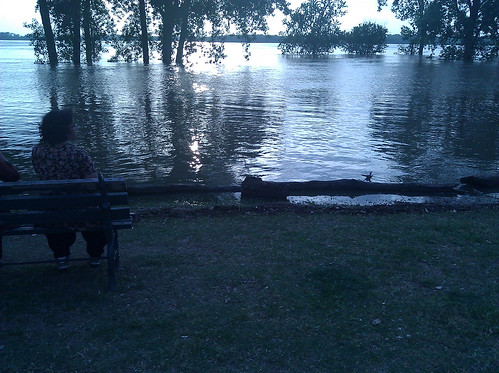
The river near flood. Taken from the pathway, normally 30 feet above the river.


River

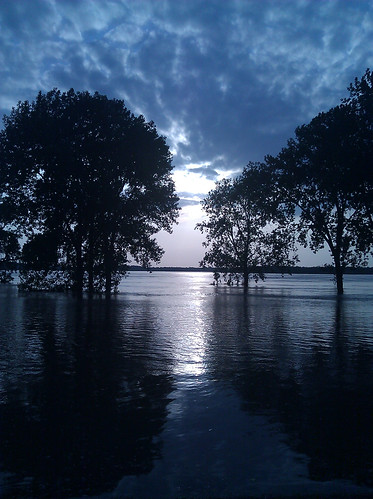
bloody wrong bloody filter for the bloody sunset. That's the river with the sun setting over Arkansas


WRlagoon

The Wolf River Lagoon, just 100 yards from my house.
You can see by the trees in the background this is 15-20 feet higher than normal.
The water is now 2 feet from the bank. Three days ago there was a six foot gap.
The water is backflowing into the lagoon again...

Sunday, May 1, 2011

Eate Itt!

Everyone's favorite, mildly psychotic rantroll, Physioprof, has been wowing the blogosphere recently with his pasta recipes. I've seen DrugMonkey, Dr. Isis and Namnezia doing same, and I hear rumors that Jason Goldman is, not just "huge on the internet in China" but in on this recipe posting too.

Recently, my highly Belov'd BlogSis Dr. Becca had a crack at Physioprof's fusilli bolognese with interesting results. Not to be out done, I thought I'd have a go at this pasta blogging shenanigans. I'm not much shakes when it comes to pasta - so much so in fact that I hardly ever cook it because it's so...meh. I figured with my Blogmates as inspiration, and some general advice from Physioprof ringing in my ears, whatever I made couldn't be worse than what I can already conjure up. It seemed that the key ingredient was patience - don't rush the sauce. And wine. Lots and lots of loverly wine. I do, after all, somewhat resemble Keith Floyd and he never cooked without a glass to hand.

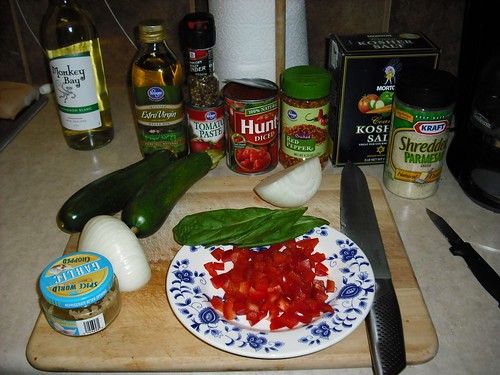
So... our obligatory still life (albeit mid-prep cos I forgot to photoblog at first)...

DSCF0176


Ingredients:
Half an onion, finely diced
Some garlic (2 big teaspoons of pre-diced)
1 red bell pepper, diced largish
2 tins diced tomatoes
2 teaspoons tomato puree
2 tablespoons EV olive oil
2 tablespoons cooking butter
3 cups rainbow rotini
1.5 cups of white wine
Red pepper flakes
kosher salt
black pepper
fresh thyme
sliced zucchini (for the side dish)

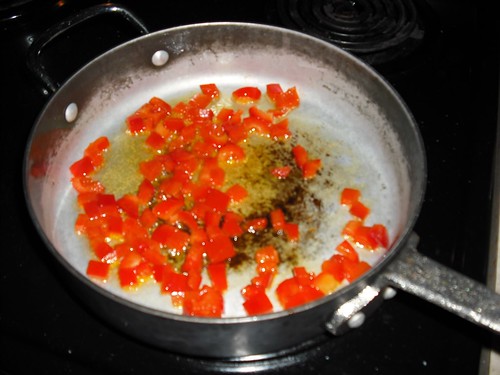
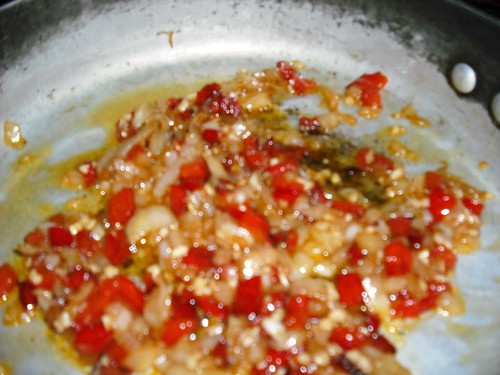
Heat the oil till it's fucken hot, then add the diced bell pepper. Cook it till it starts to blacken a little

DSCF0178

then turn the heat down a little to med-high and add the diced onion. Give it a stir and when the onion starts to turn translucent, add a generous pinch of kosher salt. This makes the onions sweat and adds to the oils the shitte is cooking in. Be patient and let this shit cook till it starts to caramelize, then turn the heat to medium and stir in the garlic. Give it another few minutes but don't let the fuckken garlic burn.

DSCF0183

Now crank the heat back to medium high and pour in a half glass of white wine. PhysioProf refers to deglazing and has some foreign sounding shit at this point. I don't know nothing about that though. The wine will reduce pretty quickly, so be prepared to move fast at this point.

DSCF0184

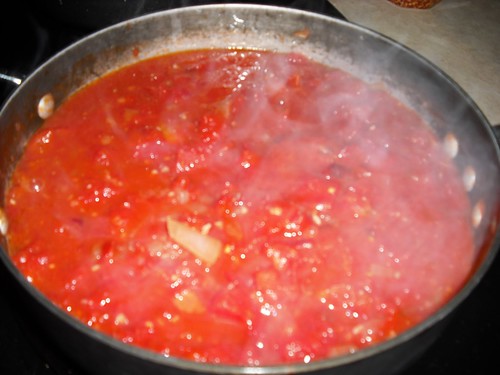
As soon as that half cup starts to boil off add the tomatoes and tomato puree and stir well. Then pour in the rest of the white wine and give it a good mixing. Keep the heat medium high till it's bubbling goode and then turn it down so it reduces slowly. You're gonna evaporate the alcohol and some of the water, but you ain't boiling it. This isn't gonna be soup. Now, keep an eye on this shitte, because it thickened way fucking faster than I thought it would.

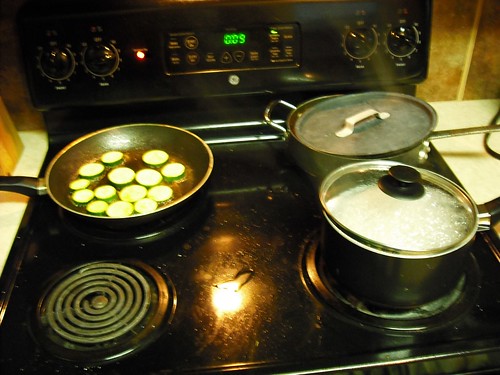
This is the point that I boiled the water for the pasta and started the courgettes zucchini. I could have probably started these guys right before the deglaze and saved a couple of minutes. As it was I ended up moving the sauce off the heat and covering it while everything else got ready, then quickly warmed it through before serving.

DSCF0186

To do the zucchini, heat the fucking butter till it's fucking really hot. Add the sliced zucchini and let it sit for a minute or two, then turn it over and get the uncooked side in the hot oil. Turn it every few minutes and you'll see it sweat and then start to blacken. Blackened zucchini is the fuking shitte, but alas, it's also easy to over cook and because of the sauce drama playing out on the other hob, I did kind of give it just a bit too long. It was still delicious though because I am awesome.

DSCF0187

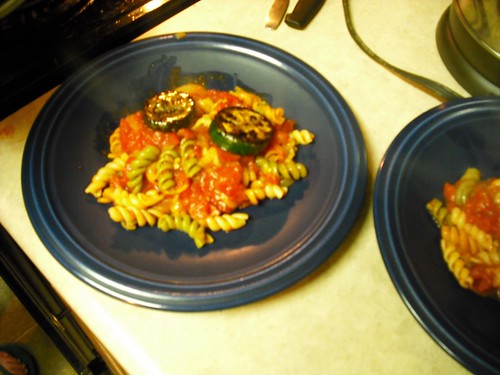
Mix the sauce and the pasta, plate that motherfucker and serve the zucchini on top.

DSCF0191

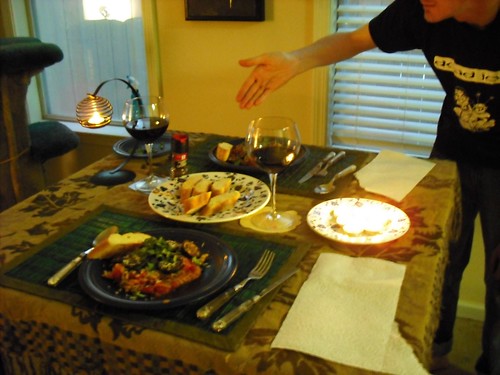
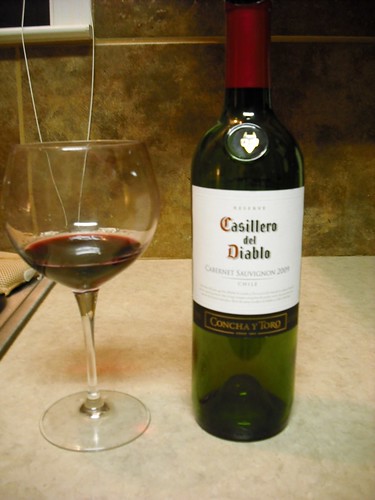
Serve with a flourish, fresh basil and parmesan, a fresh rustic baguette and a nice fucken bottle of red plonk wine - this feast brought to you by

DSCF0195


All in all it was the best damn pasta dinner I have ever cooked, and I'm actually looking forward to trying some more ideas and having more tasty feasts. So, PhysioProf thank you for the inspiration.

Saturday, April 16, 2011

Science is a Voyage


I’m the son of a sailor. My father served 35 years at sea. My uncle was a sailor too. I grew up listening to stories of adventure, both real and fictional. My favourite nautical hero is C.S. Forester’s Horatio Hornblower, likely because we share many of the same characteristics . Thanks to Forester’s meticulous attention to detail by the age of 10 I knew the names of all the sails on a ship of a line. I knew the difference between ropes and sheets (which are also ropes). I knew how to use an old sail to fother a shot below the waterline, when to run the guns out, and how to quell a mutiny. Most importantly I knew how to pronounce forecastle without being laughed at. In addition to this theory, my father taught me all the knots I’d need for my imaginary career on the high seas, and I still count time in bells to confuse my friends sometimes (7pm is 6 bells in the dog watch, for example). I’ve always had a taste for adventure and was exploring Europe with friends by my mid-teens, and had visited northern Africa before I was 21. When I was 23 I moved to the US and embarked on my greatest adventure to date.

In Nathanial Philbrick’s outstanding historical biography “Sea of Glory” we learn of the epic voyage of the U.S. Exploring Expedition of 1838-42. Although it ended in ignominy and is little known nowadays, this awesome 87,000 mile trans-global voyage officially “discovered” and first mapped Antarctica, they also created detailed maps of many of the islands of the South Pacific, and charted the Columbia River in today’s Oregon and Washington states. Finally, and vitally, their voyage lead to the establishment of the northern and western borders of the United States. In addition to these feats, in the aftermath of the voyage the US gained the US Botanic Garden and the National Observatory in Washington, D.C.

I find it not a stretch of the imagination to use these brave and foolhardy young men in a science metaphor. The seamen are the most junior scientists in this experiment. They are the graduate students and talented undergraduates. The men acting in roles we would refer to nowadays as non-commissioned officers, the First Mate, the Purser and so on are the techs – stolidly toiling away keeping the ship running, the sailors fed, the laboratories working. The junior officers – the first and second lieutenants, are the postdocs. Working under the command and direction of the Captain, they yet have tremendous latitude to advance their careers and the mission underlying the expedition. A ‘bad’ captain, think perhaps of Hornblower’s nemesis Captain Sawyer, like a bad Professor can create a terrible working environment and ruin the careers of the lieutenants working under him. A good captain, like Captain Pellew for example, can strongly advance the mission, while working to secure the careers of his trusted junior officers.

A major focus of both Philbrick’s book and Forester’s novels is not just with the adventures of the men aboard the ships, but also with the politics, the funding, the hard fought backroom battles that lead to a mission’s existence and survival. I miss being part of the voyage of discovery. I miss the excitement of the chase, the hint for the elusive result, the image, the data, the understanding. I gave that up for a corner office and a pay rise. Now I am one of the faceless suits that directs the voyage. It is on my whim that you set sail on your voyage, or languish in dry dock while your purser frantically looks for money to feed the men before mutiny sets in.

One of Hornblower’s most trusted friend’s is William Bush, who remains a lieutenant while Hornblower moves from strength to strength during the course of the novels. It is Hornblower, not Bush, who has the connections and the luck to further his career. Much like the postdoc who gets the right project under the right professor, he got his CNS papers and secured himself a tenure-track position. I was once a First Lieutenant working under a Captain who might be best described as a cross between Sawyer and Pellew. The good days were good, the bad days were terrible and it was obvious fairly on that I would never get to command my own ship. I would never be a Hornblower and couldn’t face being someone’s loyal Lieutenant Bush for ever. So I changed the rules of the game. To extend my Hornblower analogy, I went to Their Lordships at the Admiralty and asked if I could side-step that whole messy career at sea and just join in with them. To my surprise they said yes.

One day in the middle of my second postdoctoral appointment I went to the Vice Chancellor for Research and asked for help. I explained that I wasn’t going to get on the tenure-track and I knew there was little to be gained by wasting everyone’s time in applications that wouldn’t be considered. I loved science (and indeed still do). She was able to procure me an interview with someone looking for a project manager and I managed to talk my way past their hesitation and into the position. Their hesitation was obvious and they can’t be faulted for being reluctant to recruit a failed neuropharmacologist to a biomedical informatics project manager position. But with due diligence and great deal of hard work I made the job work and I remade myself from bench scientist to administrative scientist.

Now I have that corner office and healthy salary it would be easy to get complacent and become one of the dreaded Administrators of science that so clutter the Ivory Tower. I am very aware that people like me can make the life of the ‘real’ scientists incredibly difficult. We're the ones that demand you re-do your IRB, re-file your IND, we form endless committees and have endless meetings all to regulate and guide your work. Our efforts stifle your creativity and freedom. We remove the flexibility you need to explore the bounds of your imagination. Ours is a tie that binds – our endless red tape forms the Gordian knot anew.

I don’t want it to be like that. It was the vision of a few powerful and talented leaders, among them the Secretary of the Navy and President Jackson, that found the funding to get the unpopular U.S. Exploring Expedition started. If that had been modern academe it would never have happened. Too risky. Too “blue sky”.

No guaranteed return on investment.

I want to be the kind of administrator that helps drive projects to completion. I want you to succeed and I want you to be free from as much of the mundane nonsense as possible – that’s really what I’m paid to do – I’m not paid to stifle research, I’m paid to administer research. We’ll explore that in the next post (which will likely contain fewer tortuous nautical metaphors).